
Retinal Disorders
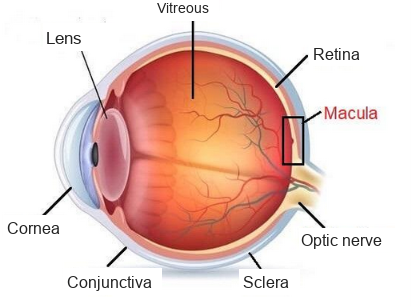
The retina is a thin membrane located at the back of the eye that detects light and converts it into nerve signals sent to the brain. It plays a central role in vision, particularly in the perception of fine details, colors, and contrast.
Conditions: Retinal Disorders
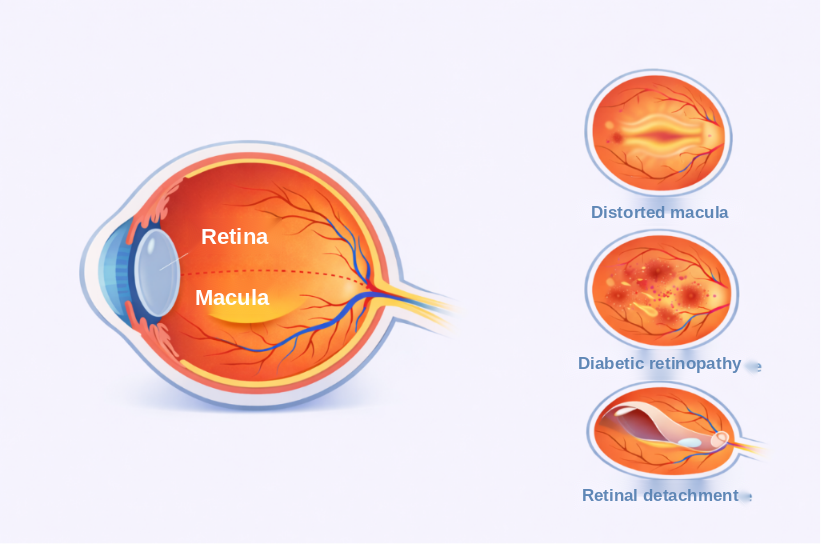
Retinal disorders encompass a range of diseases that affect the way the retina functions. They can affect different areas, particularly the macula, the central part of the retina responsible for detailed vision.
There are several types of retinal disorders:
- Age-related conditions, such as age-related macular degeneration (AMD), which affects central vision.
- Vascular conditions, such as diabetic retinopathy, caused by damage to the blood vessels in the retina.
- Retinal tears or retinal detachment, which can occur suddenly and require prompt medical attention.
- Less common inflammatory or infectious diseases.
Symptoms vary depending on the condition, but certain warning signs should prompt medical attention: reduced vision, distorted lines, the appearance of dark spots, flashes of light, or the sensation of a curtain or veil over the field of vision.
Treatment of Retinal Disorders
Treatment for retinal disorders depends directly on the underlying cause, the location of the lesion, and the stage of the disease. The goal is always the same: to preserve vision, slow the progression of the disease, and, whenever possible, repair the retina.
Intravitreal Injections
For certain conditions, such as age-related macular degeneration (AMD) or diabetic retinopathy, treatment involves injecting medication directly into the eye.
These medications act on abnormal blood vessels or fluid leakage, which can cause retinal swelling and damage. They most often help stabilize vision and can sometimes improve it.
The treatment is performed during an outpatient appointment under local anesthesia and needs to be repeated regularly depending on the progression of the condition.
Laser Treatment
Laser treatment is used to treat certain localized retinal lesions.
It can be used to “reinforce” weakened areas of the retina or treat abnormal blood vessels, particularly in diabetic retinopathy. It can also be used as a preventive measure, for example around a retinal tear, to prevent retinal detachment.
Laser treatment does not improve vision, but it can prevent the condition from worsening.
Retinal Surgery
Some conditions require surgery, particularly in cases of retinal detachment.
The procedure involves repositioning the retina and keeping it attached to the wall of the eye.
Different techniques may be used, including:
- injecting gas into the eye to push the retina back into place,
- placing an external implant to support the wall of the eye,
- vitrectomy, which involves removing the gel inside the eye (the vitreous humor) to access the retina.
Visual recovery depends on how quickly treatment is provided and on the extent of the retinal detachment.
Medical Treatment and Monitoring
In some cases, no invasive treatment is immediately necessary. Regular monitoring may be sufficient, particularly when the lesions are at an early stage or are progressing slowly.
In addition, treating the underlying cause is essential:
- maintaining good blood sugar control to limit diabetic retinopathy,
- controlling blood pressure,
- stopping smoking.
These measures can directly help slow the progression of retinal diseases.